
Improving Boat Engine Performance and Protection Data: A 2026 Guide
Table of Contents
- Why Real-Time Engine Performance Data Matters
- Understanding Your Boat Engine Diagnostic Tools
- Key Performance Metrics to Monitor
- Setting Up Engine Monitoring on Older Vessels
- Frequently Asked Questions
Last Updated: September 15, 2026
Why Real-Time Engine Performance Data Matters
Most boat owners ignore engine data until something breaks, turning a $500 problem into a $5,000 repair. Real-time monitoring catches issues before they cascade into catastrophic failure. Boats running on gut feel suffer unexpected breakdowns mid-season, while vessels with continuous monitoring see problems developing weeks in advance. A slow rise in water temperature, creeping fuel consumption increase, or subtle shift in engine load are early warning signs. Toba Marine Technology has designed monitoring solutions specifically for boat owners who want real-time visibility and reporting into engine behaviour without expensive proprietary systems.
Real-time data also optimizes efficiency. You stop guessing about fuel economy and see exactly what throttle position, RPM range, and hull condition deliver. Fishing trips become more profitable, cruising becomes cheaper, and safety improves dramatically when you know your engine's state at every moment.
Understanding Your Boat Engine Diagnostic Tools
Your engine constantly broadcasts information only if it’s a new electronic model, and even then, not necessarily all the information you might like to see. Traditional analogue gauges show snapshots: a temperature reading, pressure gauge, fuel level. Digital engine monitoring systems reveal the full picture of engine health, and in the case of this technology, customisable right around your boat and engineering systems specifically.
Digital Gauges vs. Analog Instruments
Analogue instruments are reliable and simple but completely passive. They show current conditions only, nothing about trends or what's coming next, or alert you when trouble strikes. A digital system has the ability to warn you that water temperature is trending upward 30 minutes before it reaches the danger zone, giving you time to reduce throttle or head to port safely.
Modern universal-compatible digital gauges work with any engine configuration, carbureted, fuel-injected, older mechanical systems, or newer electronic engines. Installation becomes a weekend project instead of a major refit.
Telemetry and Sensor Integration
Modern marine telemetry systems often integrate with NMEA2000 networks, a marine industry standard that lets different electronic devices communicate. Your GPS plotter talks to your autopilot. Your engine monitoring system feeds performance data to everything else on the network. One model introduced by Toba Marine Technology allows all your data, be it from an analogue source or digital, to be transmitted over NMEA2000, enabling access to that data elsewhere on the boat and by any conforming third party display.
Wi-Fi-enabled monitoring systems can receive calibration updates and new alarm thresholds without requiring a service visit. Toba Marine Technology's digital gauges include Wi-Fi software updates, meaning your monitoring capability improves over time as new features become available.
For commercial users, this technology can be used to send data in real time to the cloud for fleet oversight; the main advantage is that the makeup of the fleet’s propulsion is irrelevant. Mechanical or electronic, it simply doesn’t matter; it is all captured and delivered to a consolidated oversight platform.
Key Performance Metrics to Monitor
Not every number matters equally. Some metrics are leading indicators that problems are developing; others confirm something is already wrong.
Fuel Flow and Consumption Tracking
Fuel flow reveals three critical things: whether your engine runs efficiently, whether your fuel system works properly, and whether you're getting expected range. A healthy engine at a given throttle position burns predictable fuel per hour. When consumption climbs without throttle changes, something is wrong: leaking injectors, clogged filters, or a failing oxygen sensor. External factors also play a role; heading and deck load can be tweaked in some cases to return better fuel burn rates, though only if they are being reported.
Tracking fuel consumption also reveals hull condition. A fouled hull requires more fuel to maintain the same speed. When fuel consumption rises, but throttle stays the same, your hull probably needs cleaning. Modern fuel flow sensors integrate directly into your fuel line and report consumption in real time. Over a season, you build a baseline: "at 2000 RPM in calm water, this engine burns 8 GPH." When that number drifts to 10 GPH, you know something has changed.
Weight Distribution and Bottom Maintenance
Weight distribution affects how your boat sits in the water. Too much weight forward and you're pushing a bow wave constantly; too much weight aft and you're dragging your stern. Optimal weight distribution minimizes hull drag. Most recreational boats are designed to cruise with weight distributed roughly 40% forward, 60% aft.
Bottom maintenance is one of the highest-ROI improvements available. A boat with a clean hull and fresh bottom paint will cruise more efficiently than the same boat with a fouled hull.
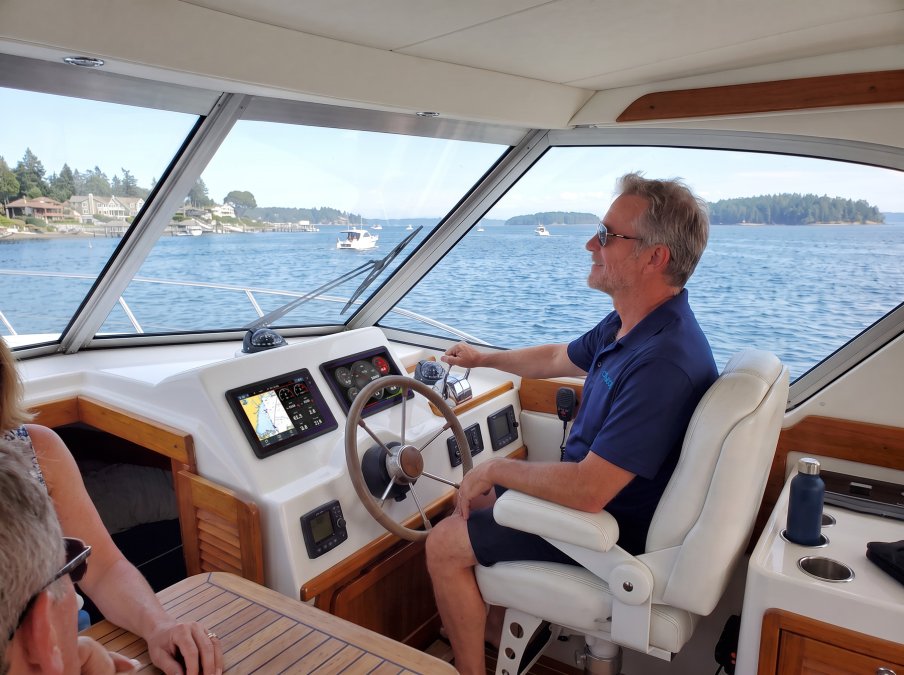
Boat helm showing digital gauge displays installed alongside an MFD and traditional analogue instruments, with real-time engine performance data visible on the digital screen in bright daylight.
Setting Up Engine Monitoring on Older Vessels
Older boats present unique challenges: mechanical fuel systems, carbureted engines, proprietary gauge systems. Yet upgrading to digital monitoring doesn't require replacing everything.
Universal Compatibility and DIY Installation
Universal compatibility means a digital monitoring system works regardless of your engine type, fuel system, or existing gauge configuration. A universal system uses sensors that measure the same physical properties every engine produces: water temperature, oil pressure, fuel flow, alternator output, RPM. These sensors connect to a central display through simple wiring or wireless transmission.
DIY installation means you can handle most work yourself. Running sensor lines from the engine compartment to the helm takes a few hours. Mounting a digital display takes minutes. Connecting power and ground to your battery is straightforward. Most boat owners with basic mechanical aptitude can complete installation in an afternoon. Toba Marine Technology's digital boat gauges unit emphasizes DIY-friendly installation because boat owners shouldn't need to hire a technician to upgrade monitoring.
Calibrating Sensors for Accurate Readings
A sensor is only useful if accurate. Miscalibrated sensors give false confidence or false alarms. Calibration means telling your monitoring system what sensor readings actually mean. A water temperature sensor reads voltage; your system converts that to degrees. If calibration is wrong, a voltage that should read 70°C (160°F) might display as 82°C (180°F).
Toba’s new MEMU-7i and 7ix technology allows for custom calibration in the unit itself. It requires no laptop, no plugins, no additional purchase of software. You simply need the sensor data for your sensor, which can be determined by the manufacturer or read with a multimeter. Those calibration points are entered once, and it takes minutes, not hours.
Reading Engine Diagnostics Data
Engine diagnostics data tells a story if you know how to read it. Rising water temperature suggests a cooling system problem, clogged intake, failing thermostat, or impeller wear. Climbing fuel consumption at fixed throttle suggests fuel system degradation or engine wear. Dropping alternator output suggests battery or charging system issues.
Establish baselines when your engine runs well. Record normal water temperature at cruise, normal fuel consumption, normal RPM, normal alternator output. These become your reference point. When any metric drifts away from baseline, something has changed.
Water temperature trends reveal cooling system problems before they become critical. A slow rise over weeks suggests the cooling system is gradually losing efficiency. Catching these early means a few hours of maintenance instead of an expensive engine overhaul.
Preventative Maintenance Using Performance Trends
Preventative maintenance fixes problems before they break your engine. Performance data lets you schedule maintenance based on actual engine condition rather than calendar intervals.
Most manufacturers recommend oil changes every 100 hours or annually. But if you monitor oil pressure trends and see stable pressure and cool running, you might safely extend that interval. Conversely, if oil pressure drops gradually, you know your oil is degrading and should change it early.
Fuel system maintenance becomes predictable when you track fuel flow. If consumption rises gradually, your fuel system needs attention before it gets worse. Clean fuel filters, run fuel system cleaner, or have injectors professionally cleaned. These interventions cost a few hundred dollars and take hours. Ignoring the trend until your engine fails costs thousands and months of downtime.
Cooling system maintenance follows the same logic. Monitor water temperature at cruise under consistent conditions. If you see a gradual rise over weeks, your cooling system is losing efficiency. Clean your intake strainer, check your thermostat, or replace your impeller. Data-driven maintenance catches problems early when they're cheap to fix, rather than late when they're expensive.
Frequently Asked Questions
Will it work with my boat?
Yes. Any boat, any engine, any system. It can be analogue, digital or a combination of both. Sensors don’t vary much between manufacturers, and if there is a sensor that is difficult to work with, it is easily changed out for one that is.
Are there any exceptions to this?
No. In fact, this solution could monitor an engine, genset, water maker or any engineering system where sensors are used to monitor the physical world i.e. pressure, temperature, voltage, movement, air fuel mixture etc.
Which model should I choose?
Toba Marine Technology make two models currently: the MEMU-7i and the MEMU-7ix. If you have older engines that are pre-electronic and you do not wish to share data with another screen over NMEA2000, the 7i is sufficient. For all other applications, the 7ix is best, as it reads engine data from NMEA2000 (or J1939) and it broadcasts to those protocols also while retaining the same analogue inputs as the 7i.
If I need extra or replacement sensors, where can I purchase those?
Your existing sensors don't need to be changed if they are in good working order. When the time comes to replace them, the Toba Marine Technology website carries a range of sensors that is expanding all the time. These are well tested by us and work perfectly with our units.
Is it difficult to install and wire the digital gauges unit to my boat?
The general rule of thumb is that if you can install a car stereo, you can install the Toba Marine Technology solution. Installation manuals are published on the website, and video support tutorials are linked on YouTube as aids for DIY installation.